LangChain
LLM Development

Stateside Digitals builds LangChain LLM applications: retrieval over your own documents, agents that carry out several steps, and tracing that shows exactly what happened when something returns the wrong answer.

What Is LangChain
And Why It Matters For Your Team

LangChain is a framework for building applications on top of language models. It provides the pieces that sit between a model and your software: connections to different providers, document loading and splitting, retrieval from vector stores, conversation memory, and orchestration for work that takes several steps rather than a single exchange.

None of that is impossible to write yourself, and plenty of capable teams do exactly that. What the framework offers is that the pieces already interoperate, so changing model provider or vector database becomes configuration rather than a refactor. Whether that trade is worth the added abstraction depends entirely on how complicated your application is.

One Interface, Many Models

Swap Providers Without Rewriting

Application logic stays separate from whichever model sits behind it, so moving between providers is a settings change rather than a project.

Traceable By Default

See Every Step It Took

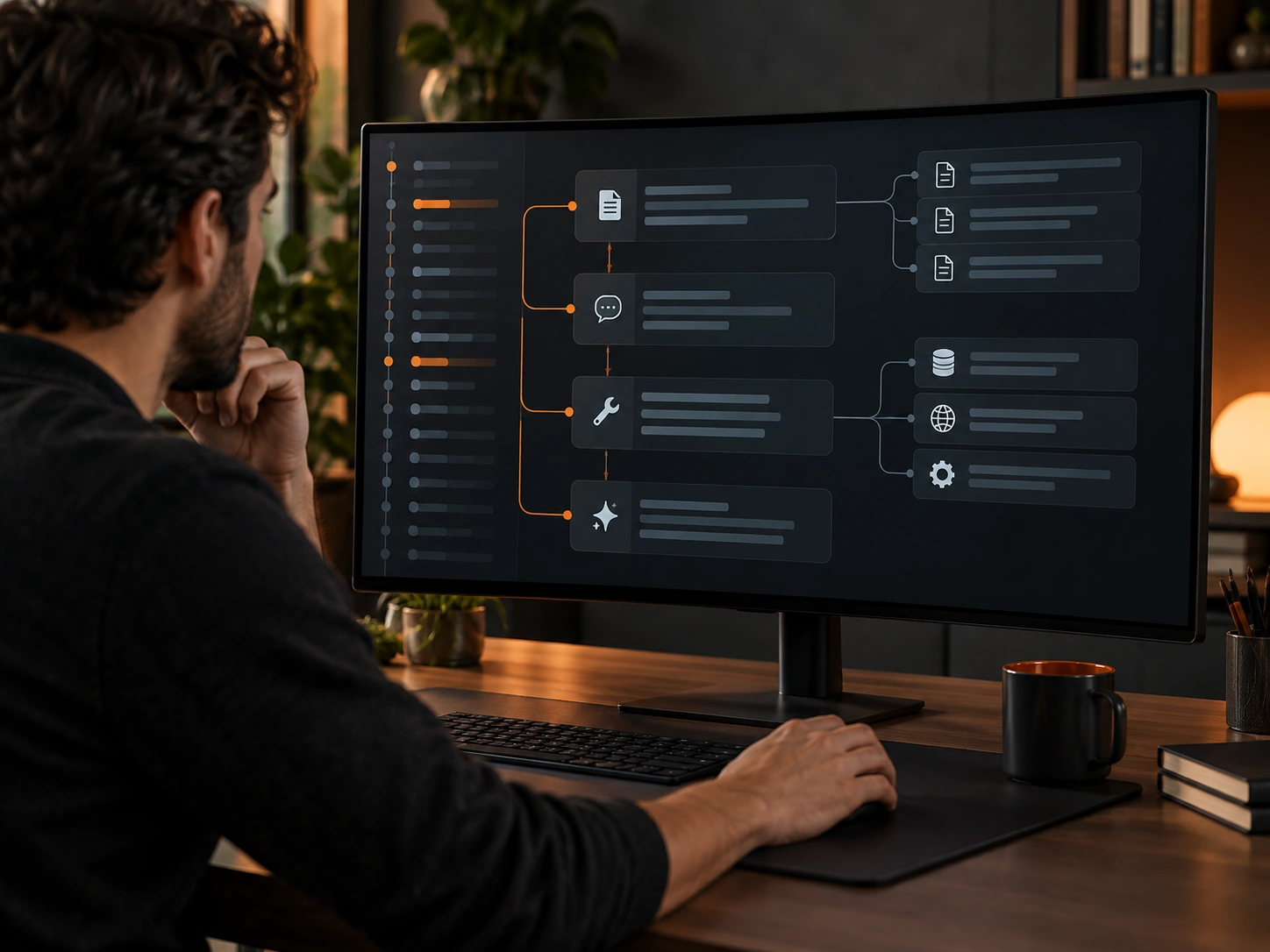
Each retrieval, prompt, and tool call is recorded, so a bad answer can be traced to its cause instead of being guessed at afterward.

Agents That Hold State

Multi-Step Work, Not One Reply

Tasks that need several decisions in sequence run as a managed graph, with defined stopping points rather than an open-ended loop.

01

Retrieval Pipelines

Chunking, embedding, and ranking your documents so the model receives the right passages rather than whatever matched a keyword.

03

Tool And API Access

Giving a model controlled access to your internal services, so it can look up an order or check availability rather than inventing one.


Is LangChain Still
The Right Choice?

It is a fair question and the skepticism was earned. Early versions wrapped straightforward API calls in layers that made debugging harder than writing the call directly would have been, and a great many experienced teams concluded they were better off without it. That criticism travelled widely and still shapes how the project is regarded today.

The framework has changed considerably since then, with agent orchestration and tracing now handled by dedicated components rather than improvised on top. Our position is that it earns its place on applications involving retrieval, several steps, and multiple tools, and does not earn it on a single prompt and a reply. We use it where complexity justifies it and go direct where it does not.

How We Build
LangChain LLM
Systems

We work in Python with LangChain for retrieval and provider abstraction, LangGraph where a task needs state across several steps, and LangSmith for tracing and evaluation. Embeddings are stored in pgvector, Qdrant, or a managed equivalent. Provider adapters cover OpenAI, Anthropic, Google, and open models, so the same application can move between them.
  • LangChain
  • LangGraph
  • LangSmith
  • Python
  • pgvector
  • Qdrant
  • OpenAI
  • Anthropic
  • Google
  • Open Models
  • Retrieval
  • Tracing

What We Use
And What We Skip

An agency that reaches for the same framework on every project is telling you about its habits rather than your problem. A fair share of the LangChain work we do is deciding which parts to leave out of a build.

Frequently Asked Questions

Do we need LangChain at all?

Frequently not. If your feature is a prompt, a response, and nothing else, calling the provider directly is simpler and easier to maintain. LangChain earns its place once retrieval, several tools, or multi-step reasoning enter the picture and coordination matters.

Which models does it work with?

How do you keep versions stable?

Can we see what the system is doing?

Who maintains LangChain?

Talk To
An Engineer

If you are weighing up how to build an LLM feature and want a technical opinion rather than a pitch, we are happy to talk through the architecture before anything is scoped.

FILL THE FORM

Stateside Digitals
@2026
LET’s CONNECT